SENSOR KHOWLEDGE HUB
Hydrogen Pressure Sensors for Safe and Stable H2 Systems
Hydrogen systems require pressure measurement at almost every stage of the H2 value chain. Pressure must be monitored during hydrogen production, compression, storage, transportation, distribution and final use. Depending on the installation, the sensor may operate at relatively moderate process pressure or in a high-pressure circuit reaching several hundred bar.
PRIGNITZ Mikrosystemtechnik develops hydrogen pressure sensors for industrial systems, energy installations, storage equipment, mobility applications and fuel-cell technology. The portfolio includes standard pressure transmitters, compact OEM sensors, configurable high-accuracy transmitters and versions intended for hazardous areas.
The available portfolio covers nominal pressure ranges from 4 to 1,000 bar. Selected configurable versions can also cover measuring ranges beginning at minus 1 bar. The exact measuring range, pressure connection, electrical output, temperature range and certification depend on the selected sensor version.
Why hydrogen pressure measurement requires a dedicated sensor design
Hydrogen presents particular challenges for pressure measurement equipment. Under certain operating conditions, hydrogen can penetrate metallic materials and contribute to permeation and hydrogen embrittlement. The actual level of risk depends on factors such as the material, mechanical stress, hydrogen pressure, temperature, exposure time and manufacturing quality.
Conventional pressure transmitters may contain welded diaphragms, elastomeric seals or an internal pressure-transfer fluid. Each additional interface can become a potential weak point in demanding hydrogen applications. Hydrogen entering an oil-filled measuring system can also affect measurement stability over time.
For this reason, the selection of a hydrogen pressure sensor should not be based only on measuring range and output signal. The material in contact with the medium, the construction of the measuring cell, the number of internal joints and seals, resistance to mechanical loads and the suitability of the complete sensor configuration must also be considered.
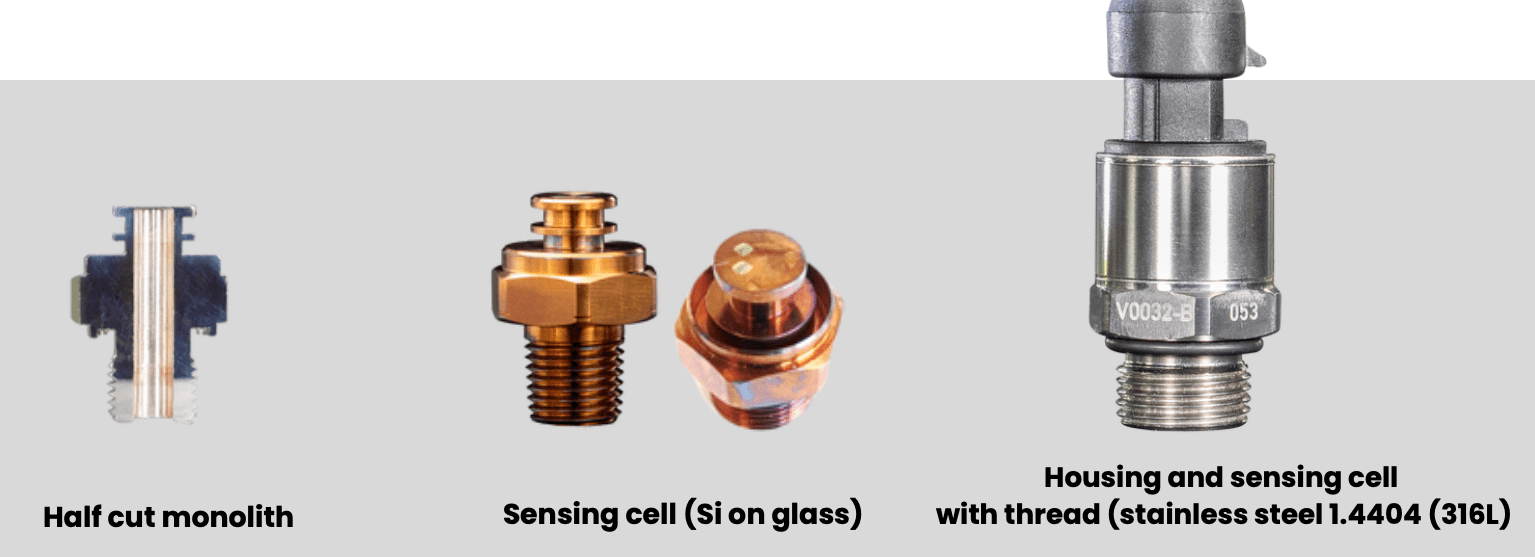
The hydrogen sensor portfolio from PRIGNITZ Mikrosystemtechnik uses wetted parts made from stainless steel 1.4404, corresponding to AISI 316L. The measuring element is manufactured as a monolithic component without internal welded seams. The standard hydrogen versions are also designed without internal elastomer seals and without a pressure-transfer oil reservoir. This construction reduces the number of internal interfaces and potential leak paths exposed to hydrogen.
P2P technology for mechanical stability
Hydrogen pressure sensors from PRIGNITZ Mikrosystemtechnik are based on patented P2P technology.
The measuring principle uses two piezoresistive Wheatstone full bridges. A Wheatstone bridge is an electrical measuring circuit that converts very small mechanical deformation of the sensing element into a measurable electrical signal.
The two full bridges are interconnected so that unwanted external mechanical influences on the sensor signal are largely compensated. These influences can include installation-related forces, housing stress and torque applied during mounting.
This is particularly relevant in compact valve blocks, mobile equipment, compressor systems and OEM assemblies where the sensor housing can be exposed to vibration, shock and mechanical loading. The technology is intended to improve signal stability without requiring a large oil-filled isolation system.
The monolithic 316L measuring body and the dual-bridge construction therefore address two different requirements:
- Resistance of the wetted sensor structure to the hydrogen medium.
- Reduced sensitivity of the measuring signal to external mechanical forces.
P2P-based sensors are available in the standard S100 and S200 pressure transmitter families as well as the configurable C100 family.
Pressure sensors across the hydrogen value chain
Hydrogen pressure measurement is not limited to fuel cells. Pressure sensors can be required at multiple points between hydrogen production and final consumption.
Hydrogen production and electrolysis
In electrolysis systems, water is separated into hydrogen and oxygen using electrical energy. Pressure measurement may be required in hydrogen outlet circuits, gas-conditioning equipment and downstream balance-of-plant components.
Stable pressure information supports the control of process equipment and allows the control system to identify pressure deviations. The required sensor configuration depends on the electrolyser technology, pressure level, gas purity, installation environment and operating temperature.
Pressure sensors may also be used in hydrogen production systems based on other processes. The suitability of the sensor must always be verified for the actual medium composition and process conditions.
Hydrogen compression
Compression is necessary when hydrogen must be stored, transported or supplied at a higher pressure.
Pressure sensors can be installed at compressor inlets and outlets, between compression stages, in cooling circuits, valve assemblies and downstream storage systems. These measuring points may be exposed to pressure pulsation, vibration and rapid pressure changes.
The standard PMP-S122-H and compact PMP-S222-H provide a response time of up to 2 milliseconds, according to their current technical datasheets. Both series are also tested for vibration resistance of 20 g in accordance with IEC 60068-2-6.
Hydrogen storage systems
Hydrogen can be stored in stationary tanks, mobile storage modules, cylinder bundles and vehicle tanks.
Pressure measurement provides information about the operating condition of the storage system and can be used by the control unit for monitoring, filling control and system diagnostics. Sensors may be integrated directly into a valve assembly, pressure regulator, manifold or tank-related control module.
The PMP-S222-H is particularly suitable for compact OEM integration. The sensor has a compact housing, a typical weight of approximately 50 grams and a selection of automotive and industrial electrical connectors, including Packard Metri-Pack, Deutsch DT and AMP Superseal variants.
The earlier PRIGNITZ Mikrosystemtechnik Application Note shows an example of the PMP-S222-H integrated into a solenoid valve mounted on a hydrogen tank assembly.
Hydrogen transport and distribution
Hydrogen can be transported in trailers, storage modules and pipelines. Pressure measurement is required to monitor the condition of the gas during loading, transportation, unloading and transfer between system components.
Depending on the application, the pressure sensor may be installed in a main gas line, manifold, valve block or pressure-reduction stage. Mechanical connection, pressure type and electrical interface must be selected according to the system design.
PRIGNITZ Mikrosystemtechnik offers gauge-pressure and sealed-reference configurations. A sealed-reference sensor measures pressure relative to a sealed reference chamber and is commonly used for higher pressure ranges where atmospheric pressure variation has little influence on the total measurement.
Hydrogen refuelling equipment
Hydrogen refuelling installations contain storage, compression, pressure-regulation and dispensing equipment. Different parts of the installation operate at different pressure levels.
Pressure sensors may support the control and monitoring of storage banks, compressor systems, valve assemblies and gas-transfer lines. However, the selected sensor must be assessed as part of the complete refuelling system. Pressure range alone does not determine suitability for a particular refuelling application.
For installations classified as hazardous areas, PRIGNITZ Mikrosystemtechnik offers selected intrinsically safe, non-sparking and flameproof pressure transmitter versions. The applicable ATEX, IECEx or CSA certification depends on the precise model, electrical connection and configuration.
Hydrogen mobility
Hydrogen pressure sensors can be integrated into mobile storage systems and fuel-supply equipment used in buses, trucks, forklifts, construction machinery and other hydrogen-powered vehicles.
Compact sensors may be installed in tank valves, pressure regulators, manifolds and supply lines. Mobile applications place additional demands on vibration resistance, shock resistance, electromagnetic compatibility and connector reliability.
The PMP-S222-H was designed for OEM series applications and harsh mobile environments. Its technical documentation lists transportation, off-highway equipment and renewable-energy systems among its application areas.
The PRIGNITZ Mikrosystemtechnik Application Note also presents hydrogen buses, forklifts, e-bikes and drones as examples of actual or potential application environments for the company’s hydrogen pressure sensors.
Fuel-cell systems
Fuel cells convert hydrogen and oxygen into electrical energy. Pressure sensors can support the control of hydrogen supply pressure upstream of the fuel-cell stack and within the associated gas-distribution system.
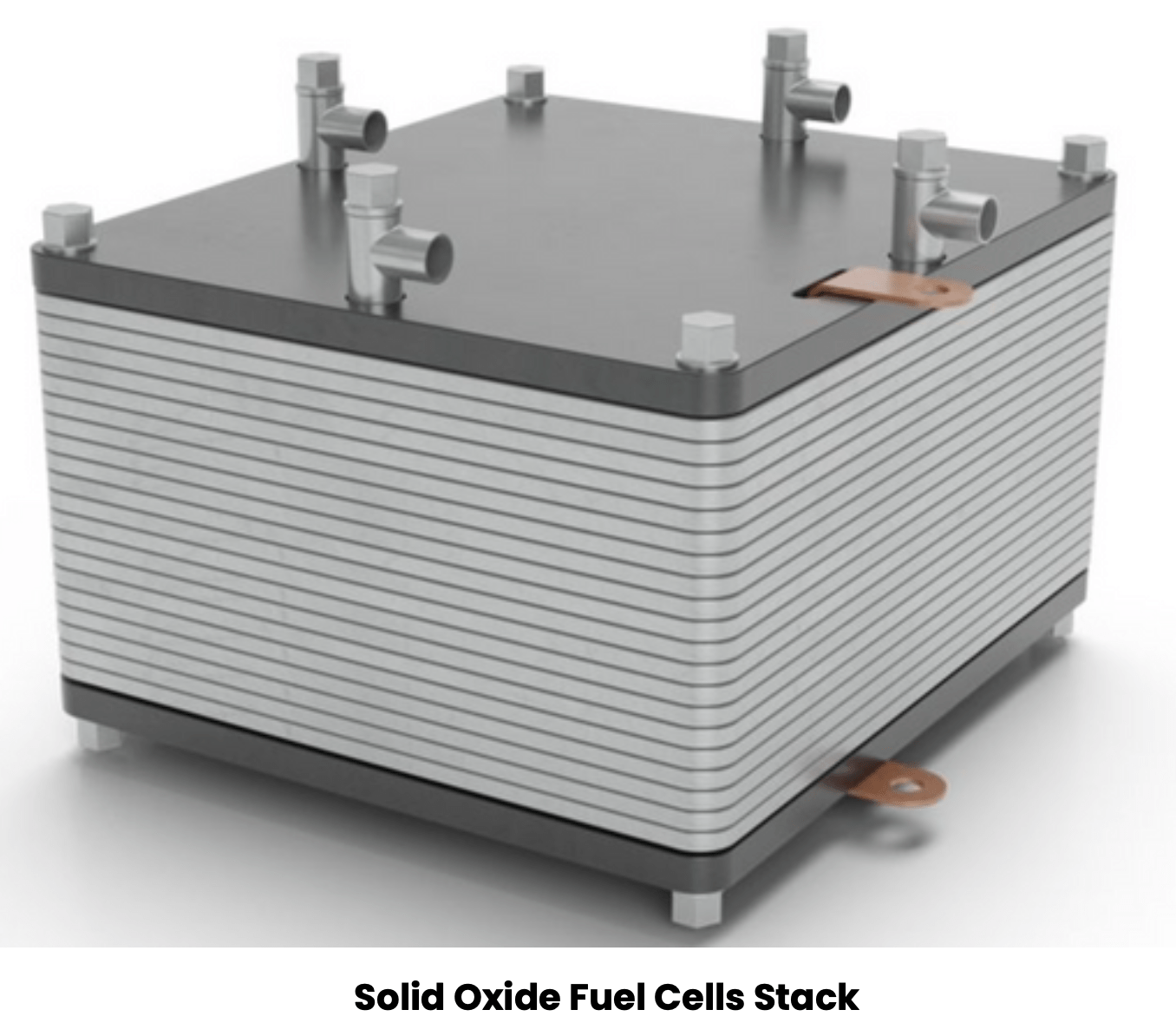
In a solid oxide fuel cell, or SOFC, pressure measurement can be used to monitor fuel delivery and the distribution of gas through the stack manifolds. Stable gas pressure supports consistent distribution across individual cells.
In proton-exchange membrane fuel cells, or PEM fuel cells, pressure measurement may also be required in the hydrogen supply circuit, recirculation system and associated balance-of-plant equipment. The exact sensor range and installation point depend on the fuel-cell architecture.
The sensor should therefore be selected for the complete operating profile rather than solely for the nominal stack pressure. Start-up conditions, pressure peaks, purging cycles, temperature and possible pressure pulsations must also be considered.
Technical characteristics of PRIGNITZ hydrogen pressure sensors
The exact specifications depend on the selected model and configuration. The main available characteristics include:
| Parameter | Available characteristics |
|---|---|
| Nominal pressure ranges | Generally 4 to 1,000 bar |
| Configurable ranges | Selected versions from minus 1 to 1,000 bar |
| Wetted material | Stainless steel 1.4404, AISI 316L |
| Measuring technology | Piezoresistive P2P dual-bridge technology |
| Standard accuracy at 25 degrees Celsius | Up to 0.5 percent FS |
| Configurable PMP-C122-H accuracy | Up to 0.25 percent FS |
| Response time | Up to 2 ms for PMP-S122-H and PMP-S222-H |
| Configurable-series response time | Up to 4 ms, depending on configuration |
| Medium temperature | Up to minus 40 to plus 125 degrees Celsius for selected standard versions |
| Long-term stability | Plus or minus 0.1 percent FS per year under reference conditions |
| Vibration resistance | 20 g according to IEC 60068-2-6 |
| Pressure cycles | More than 10 million cycles |
| Pressure types | Gauge and sealed reference |
| Typical outputs | 4 to 20 mA, 1 to 5 V and 0.5 to 4.5 V ratiometric |
| Hydrogen approval | EC 79/2009 hydrogen type approval up to 600 bar, as stated in current datasheets |
| Hazardous-area options | Selected ATEX, IECEx and CSA versions |
FS means full scale, or the complete calibrated measuring span of the sensor. An accuracy of 0.5 percent FS means that the stated error is calculated relative to the full measuring range, not relative to the current pressure reading.
These values must not be applied automatically to every product configuration. In particular, temperature limits, output signals, ingress-protection ratings and hazardous-area certifications differ between sensor versions.
Hydrogen pressure sensor portfolio
PMP-S122-H
The PMP-S122-H is a standard high-pressure transmitter for industrial hydrogen applications.
Main characteristics include:
- Nominal pressure ranges from 4 to 1,000 bar.
- Accuracy up to 0.5 percent FS at 25 degrees Celsius.
- Response time up to 2 milliseconds.
- Medium temperature from minus 40 to plus 125 degrees Celsius.
- Multiple NPT, UNF and G-thread process connections.
- Current, voltage and ratiometric output options.
- Gauge or sealed-reference pressure measurement.
- Hydrogen type approval up to 600 bar according to the current datasheet.
The PMP-S122-H is suitable where a robust standard transmitter with a broad selection of mechanical and electrical interfaces is required.
PMP-S222-H
The PMP-S222-H is a compact pressure transmitter developed for OEM series integration and demanding mobile or industrial environments.
Main characteristics include:
- Nominal pressure ranges from 10 to 1,000 bar on the current portfolio page.
- Compact construction and high integration density.
- Typical weight of approximately 50 grams.
- Accuracy up to 0.5 percent FS at 25 degrees Celsius.
- Response time up to 2 milliseconds.
- Automotive and industrial connector options.
- Optional diagnostic functionality based on the output signal.
- More than 10 million specified pressure cycles.
This model can be considered for tank-related valve units, mobile hydrogen systems and serially manufactured equipment where installation space and connector selection are important.
PMP-C122-H
The PMP-C122-H is a configurable pressure transmitter for applications requiring higher accuracy and adjustable signal conditioning.
Main characteristics include:
- Configurable pressure ranges from minus 1 to 1,000 bar.
- Accuracy up to 0.25 percent FS at 25 degrees Celsius.
- Microprocessor-based signal compensation.
- Zero-point correction.
- Measuring-range adjustment.
- Signal filtering.
- Response time up to 4 milliseconds, depending on configuration.
- Current, voltage and ratiometric output options.
The PMP-C122-H is suitable when the measuring range, signal behaviour or output configuration must be adapted more precisely to a particular hydrogen system.
Hydrogen sensors for hazardous areas
Selected S122 and C122 versions are available for classified hazardous locations.
The portfolio includes:
- Exi intrinsically safe pressure transmitters.
- ExnA non-sparking pressure transmitters.
- ExD flameproof-enclosure pressure transmitters.
- Selected ATEX, IECEx and CSA configurations.
The required certification must be selected according to the hazardous-area classification, gas group, temperature class, zone or division, electrical connection and local regulatory requirements. It is not sufficient to select a sensor only because the model name contains an Ex designation
How to select a hydrogen pressure sensor
The following parameters should be defined before selecting a sensor.
Normal operating pressure
The nominal measuring range should cover the normal process pressure while providing sufficient measurement resolution.
Maximum pressure and pressure peaks
The expected overpressure, pulsation and possible transient pressure peaks must be compared with the overpressure and burst-pressure values in the relevant datasheet.
Hydrogen medium and process conditions
The gas composition, purity, humidity, temperature and possible presence of other process media must be evaluated.
Pressure reference
The system designer must determine whether gauge pressure or sealed-reference pressure is required.
Process connection
The thread and sealing concept must match the valve, manifold, pipeline or tank assembly. Available connections include selected NPT, UNF and metric or G-thread versions.
Electrical interface
Typical options include 4 to 20 mA, voltage outputs and 0.5 to 4.5 V ratiometric signals. The output must be compatible with the control unit, programmable logic controller or vehicle electronics.
Temperature
Medium temperature, ambient temperature and storage temperature must be evaluated separately. Ex-certified models may have different temperature limits from standard versions.
Mechanical environment
Vibration, shock, installation forces and the permitted tightening torque must be considered. The current product datasheets specify a typical tightening torque of 25 Nm and a maximum value of up to 50 Nm for the listed standard process connections.
Hazardous-area requirements
Where the installation is classified as a hazardous area, the exact certification and installation conditions must be confirmed before ordering.
Series production or configurable solution
The PMP-S222-H is oriented towards compact OEM series integration. The PMP-S122-H provides a broad standard configuration range. The PMP-C122-H offers higher accuracy and configurable signal processing.
Pressure sensors are not hydrogen leak detectors
A hydrogen pressure sensor measures the mechanical pressure of the process medium inside a tank, pipe, valve or machine.
It does not measure the concentration of hydrogen in the surrounding air and does not replace a hydrogen leak detector.
Hydrogen installations may therefore require both types of instruments:
- Pressure sensors for monitoring the process pressure inside the system.
- Gas detectors for detecting escaped hydrogen in the surrounding environment.
The safety concept must be developed for the complete installation and cannot be provided by one pressure sensor alone.
FAQ section
What pressure ranges are available for hydrogen applications?
The standard PRIGNITZ Mikrosystemtechnik hydrogen sensor portfolio covers nominal ranges from 4 to 1,000 bar. Selected configurable versions can cover ranges beginning at minus 1 bar.
Which material comes into contact with hydrogen?
The wetted measuring element is made from stainless steel 1.4404, corresponding to AISI 316L.
What is the difference between PMP-S122-H and PMP-S222-H?
The PMP-S122-H is a flexible standard industrial transmitter with a broad range of connections. The PMP-S222-H is a more compact model developed for OEM series integration and mobile or space-constrained equipment.
Which sensor provides the highest accuracy?
The configurable PMP-C122-H provides accuracy up to 0.25 percent FS at 25 degrees Celsius. Standard PMP-S122-H and PMP-S222-H versions provide accuracy up to 0.5 percent FS.
Can the sensors be installed in hazardous areas?
Selected intrinsically safe, non-sparking and flameproof versions are available. The precise ATEX, IECEx or CSA certification must be checked for the selected model and configuration.
Are these sensors suitable for hydrogen leak detection?
No. These products measure process pressure. A separate hydrogen gas detector is required to measure hydrogen concentration in the surrounding air.
Related PRIGNITZ Mikrosystemtechnik solutions
PRIGNITZ Mikrosystemtechnik develops pressure sensors and customised sensor solutions for industrial applications where reliable measurement, robust design and application-specific configuration are required.
Find out more information about our pressure sensors solutions here or contact our sales team info@prignitz-mst.de or call +49 (0) 38 77 5 67 46-0

Would you like us to contact you within 24 hours?
Complete the form below:
Telefon: +49 (0) 38 77 / 5 67 46-0
Fax: +49 (0) 38 77 / 5 67 46-18
Mail: info@prignitz-mst.de
Contact us to discuss a customized sensor solution for your application.
© PRIGNITZ Mikrosystemtechnik GmbH 2024
All rights reserved. / Alle Rechte vorbehalten.
