SENSOR KHOWLEDGE HUB
Testarticle2
Hydrogen systems, hazardous areas, extreme pressure and connected automation impose different operating demands. The underlying benchmark is the same: stable signals and mechanical robustness under real-world conditions.
Why Pressure Sensor Architecture Matters Under Real-World Conditions
Industrial pressure sensors are no longer assessed only by the measurement value they deliver under controlled laboratory conditions. Engineers also need to know how consistently a sensing architecture performs under vibration, shock, installation-induced loads, aggressive media and changing pressure cycles. In mobile machinery, process plants and OEM series production, the mechanical and electrical architecture behind the sensor is therefore becoming as important as the nominal measurement specification.
How Patented P2P Technology Compensates External Mechanical Forces
PRIGNITZ Mikrosystemtechnik addresses these requirements with its patented P2P technology. The piezoresistive design uses two interconnected full-bridge circuits. Their configuration largely compensates unwanted external mechanical forces that could otherwise affect the sensor signal, including torque introduced during installation.
Depending on the sensor variant, P2P designs use a one-piece stainless-steel sensing element without internal welds or seals. In hydrogen-specific versions, the wetted element is made from 316L stainless steel. This combination creates a scalable pressure sensor platform rather than a single-purpose sensor design.
A Scalable Platform for Hydrogen Pressure Measurement
Scalability is especially relevant in hydrogen pressure measurement. Sensors must deliver accurate readings while remaining stable under vibration, mechanical loads and chemically demanding media. PRIGNITZ Mikrosystemtechnik offers hydrogen pressure sensors based on P2P technology for pressure ranges from 4 to 1,000 bar. The portfolio includes standard, configurable and certified versions for safety-critical systems and hazardous areas.
Pressure Sensors for Hazardous Areas
In hazardous areas, certification is necessary but not sufficient. Signal stability must also be maintained under actual mechanical and thermal loading. P2P technology addresses this at the design level by combining force compensation, media-resistant construction and reproducible sensor behavior. This supports reliable pressure monitoring as part of plant safety.
Depending on the model, hydrogen and hazardous-area pressure sensors are available in intrinsically safe (Ex i), non-sparking (Ex nA) and flameproof enclosure (Ex d) versions.
Digital Pressure Sensors for Connected Automation
Modern pressure sensors must integrate into networked automation architectures as well as hydraulic and process systems. PRIGNITZ Mikrosystemtechnik offers pressure sensors with digital interfaces, including IO-Link, I2C, PWM, CAN and Modbus RTU, depending on the product family. This allows the same sensing principles to support demanding media and load conditions while providing machine-level and system-level data connectivity.
PMP-S221: Extending P2P Technology to 5,000 Bar
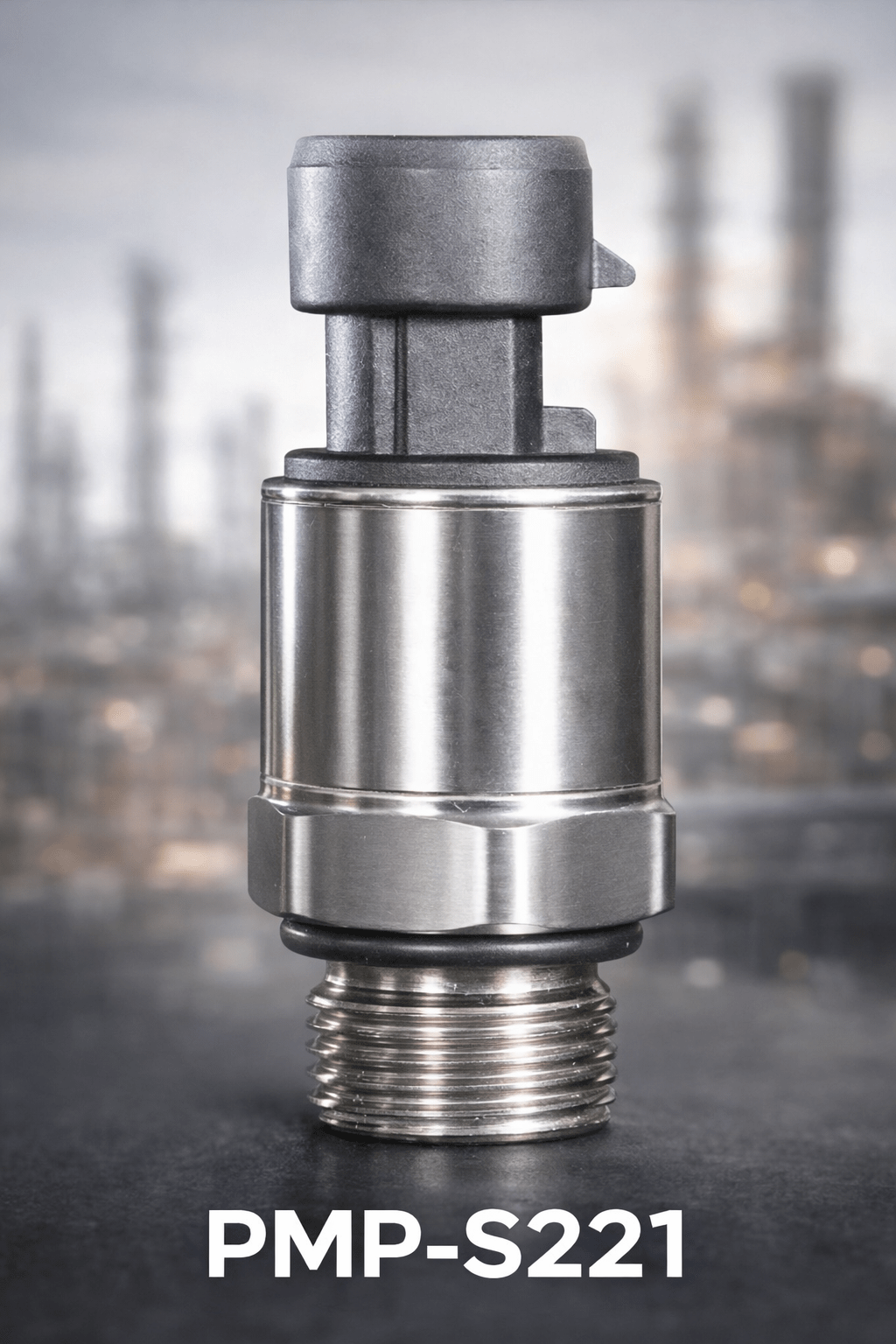
High-pressure applications demonstrate the scalability of P2P technology. The PMP-S221 converts the platform into a compact OEM pressure transmitter for high overpressure and aggressive media. According to the April 2025 datasheet, it covers pressure ranges from 10 to 5,000 bar, offers a typical response time of 1 ms and an accuracy of ≤ 0.5% FSO. It is rated for shock resistance up to 1,000 g in accordance with IEC 60068-2-32 and vibration resistance up to 20 g in accordance with IEC 60068-2-6.
The PMP-S221 is designed for OEM series use in harsh environments, particularly off-highway mobile equipment and other applications exposed to high pressure loads, shock, vibration and demanding media.
One Pressure Sensor Platform for Multiple Demanding Applications
The core value is not limited to one pressure sensor model. P2P is a patented measurement architecture that can be configured for hydrogen, hazardous areas, digital automation and high-pressure measurement.
For engineers and OEMs, this reduces the need to evaluate entirely different sensing principles for every application. The platform can be adapted to the required pressure range, materials, approvals, output signal and system interface while retaining its focus on signal stability, mechanical robustness and repeatable performance.
Key Technical Takeaways
· Two interconnected full-bridge circuits help reduce the effect of installation-induced mechanical forces on the sensor signal.
· Relevant P2P variants use a one-piece stainless-steel sensing element without internal welds or seals.
· Hydrogen pressure sensors based on P2P technology cover pressure ranges from 4 to 1,000 bar.
· Digital interfaces include IO-Link, I2C, PWM, CAN and Modbus RTU, depending on the product family.
· The PMP-S221 extends the platform to 5,000 bar with a typical 1 ms response time, accuracy of ≤ 0.5% FSO, 1,000 g shock resistance and 20 g vibration resistance.
Related PRIGNITZ Mikrosystemtechnik solutions
PRIGNITZ Mikrosystemtechnik develops pressure sensors and customised sensor solutions for industrial applications where reliable measurement, robust design and application-specific configuration are required.
Find out more information about our pressure sensors solutions here or contact our sales team info@prignitz-mst.de or call +49 (0) 38 77 5 67 46-0

Would you like us to contact you within 24 hours?
Complete the form below:
Telefon: +49 (0) 38 77 / 5 67 46-0
Fax: +49 (0) 38 77 / 5 67 46-18
Mail: info@prignitz-mst.de
Contact us to discuss a customized sensor solution for your application.
© PRIGNITZ Mikrosystemtechnik GmbH 2024
All rights reserved. / Alle Rechte vorbehalten.


